
In brief
Sour coffee is almost always under-extracted. Water pulls flavor out of coffee in a rough order. Perfect Daily Grind puts it as fruity and acidic notes first, then sweetness and balance, then bitterness. Stop too early and you get the acids without the sugars that balance them.
The fix is to extract more. Grind finer first, because grind size is the biggest lever. If that is not enough, let the brew run longer or use hotter water. Check your ratio last.
Change one thing per brew, and taste each time. If you change grind and temperature together, you will not know which one helped.
What you'll need
- Check price — Amazon →
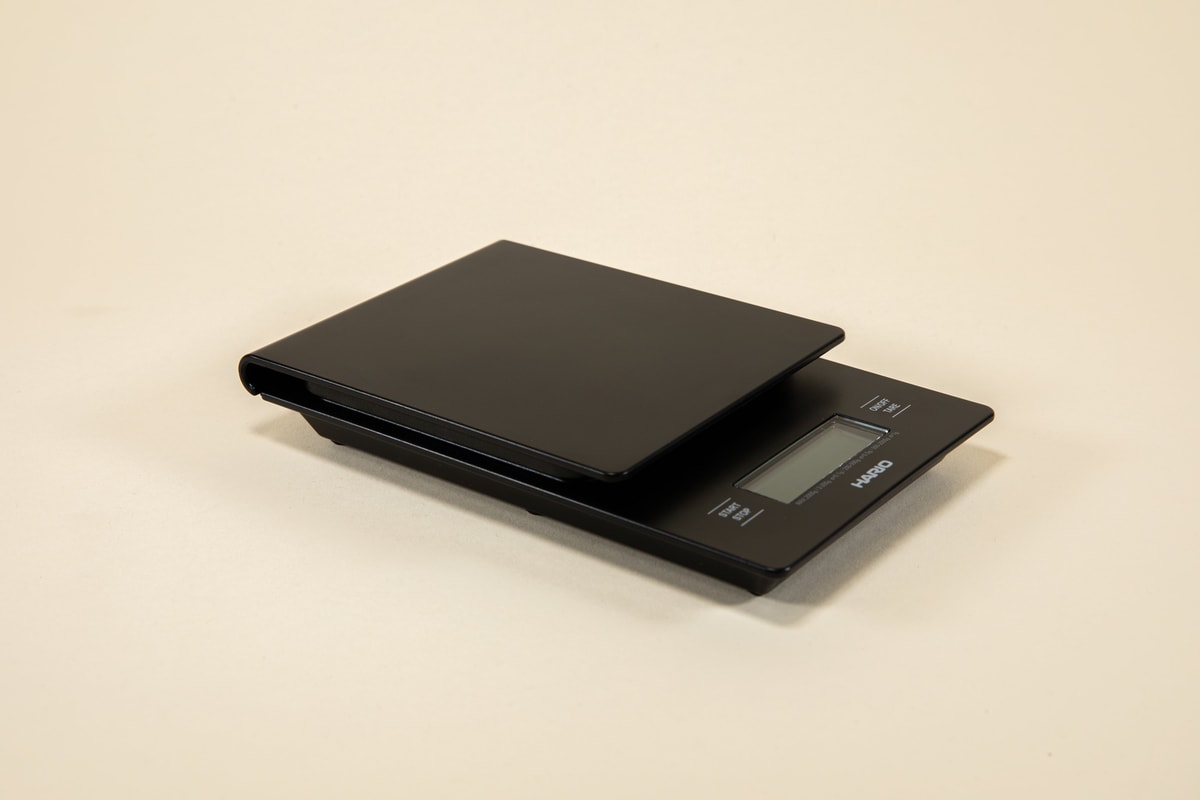 V60 Drip ScaleWeighs dose and water and times the brew, so you change one thing at a time
As an Amazon Associate, BrewMark earns from qualifying purchases.All the gear our guides use →
On this page · 8 sections
1. Confirm it is sourness, not bright acidity
Taste the cup and decide whether it is sour and thin, or bright and sweet. A good light roast is meant to be lively. That is acidity doing its job, and it comes with sweetness behind it.
Under-extracted coffee is different. Perfect Daily Grind describes it as lacking "the sweetness and slight bitterness needed for balance." It tastes sharp, short and hollow.
If the cup is sweet and juicy, nothing is wrong. If it is sharp and empty, keep going.
2. Grind finer
Move your grinder one or two settings finer and brew again with everything else the same. Finer particles have more surface area, so water extracts them faster. Baratza's V60 guide uses the same one-or-two-setting step for adjusting flow.
On a pour-over, a finer grind also slows the drawdown, which adds contact time. That is two pushes toward more extraction from one change. Baratza notes that a brew which finishes in under three minutes can still taste clean and balanced, so a quick finish alone is not proof of a problem. Taste decides.
If you are not sure where to start on your grinder, the grind converter translates a known setting into your grinder's numbers.
3. Lengthen the brew
If finer grinding starts to clog the filter or makes the cup harsh, add time another way. Perfect Daily Grind suggests "a slower brew or finer grind" for sour coffee, and notes that short brews tend to be more acidic.
How you add time depends on the brewer:
| Brewer | How to extend contact time |
|---|---|
| Pour-over | Pour more slowly, or wait longer between pours |
| French press | Steep longer before pressing |
| AeroPress | Wait longer before pressing |
| Espresso | Grind finer so the shot runs slower |
For espresso, Breville points to grind size first. A shot that runs too fast usually needs a finer grind.
4. Check your water temperature
Use hot water. Perfect Daily Grind gives about 195–205°F (91–96°C) as the ideal range, and notes that the hotter the water, the more quickly extraction happens. Water that is too cool makes extraction take much longer.
Recommendations vary at the top end. Baratza's V60 recipe calls for 210°F (98°C), above Perfect Daily Grind's range. This is a contested point, so if you are already in the range and the cup is still sour, go back to grind and time.
5. Weigh your dose and water
Weigh your coffee and water on a scale and check the ratio. Baratza's V60 recipe uses 20 g of coffee to 320 g of water, a 1:16 brew ratio. If you have been scooping, your real ratio may be well off what you think.
A ratio problem tastes different from an extraction problem. Too much water makes coffee thin and weak. Sourness is about extraction, so fix grind, time and temperature first, then adjust the ratio for strength. The brew calculator works out water for any dose.
6. Rule out stale coffee
If the coffee is flat and sour no matter what you change, check the beans. Breville lists stale coffee as its own problem, caused by old beans or too long a gap between grinding and brewing.
Grind just before you brew. If you buy pre-ground coffee, or have had a bag open for weeks, try a fresh bag before you change anything else. See how to store coffee beans to keep the next bag fresh.
Why did my coffee turn sour with a new bag?
Different coffees extract differently, so a setting that worked for one bag can under-extract the next. Start one or two settings finer than your old setting and taste. The full routine is in how to adjust grind for a new bag of coffee.
Can coffee be sour and bitter at the same time?
Yes. That usually means uneven extraction: some coffee is under-extracted while some is over-extracted. In pour-over, clogged filters and channels in the bed can cause it. In espresso it is the classic sign of channeling. Grinding finer will not fix it, because the cause is uneven flow. See how to fix espresso channeling or, for pour-over, the guide to fixing a slow drawdown.
Sources
- Perfect Daily Grind: Coffee extraction and how it helps create the perfect cup
- Baratza: Hario V60 brew guide
- Breville: Espresso machine problems and fixes
By Jeff Gluck · Checked Oct 21, 2026