
 Mahlkönig VTA 6S W
Mahlkönig · Dial-in chart
Mahlkönig VTA 6S W grind settings
On the Mahlkönig VTA 6S W, start pour over at 7, espresso at 3.5 and French press at 11.3. Every other method, with the range to adjust in, is below.
The shape of this dial
The top line is the universal grind index every BrewMark recipe uses. The bottom line is the VTA 6S W’s own dial. The connectors show how one maps onto the other.
VTA 6S W grind size chart, by brew method
Start at the recommended setting, brew, then move within the range by taste. Sour or weak means go finer; bitter or harsh means go coarser.
| Method | Setting | Range |
|---|---|---|
| EspressoFine. Aim for a 25–30s shot and adjust from there. | 3.5estimated | 2.5 – 4.8 |
| Moka potFiner than filter, coarser than espresso. No tamping. | 5.4estimated | 4.8 – 5.7 |
| AeroPress (short steep)For 1–2 minute recipes. Go coarser for longer steeps. | 6.1estimated | 5.7 – 6.6 |
| Pour over — V60 / coneThe reference point for most published pour-over recipes. | 7estimated | 6.6 – 7.8 |
| SiphonMedium. Short contact over steady heat, so start here and taste. | 7.4estimated | 6.8 – 8.3 |
| Pour over — flat bottomKalita, Orea and similar. Slightly coarser than a cone. | 7.8estimated | 7.1 – 8.7 |
| Steep and release — Clever / SwitchSteep, then drain through a paper filter. If it drains slowly, go coarser. | 8.2estimated | 7.4 – 9.1 |
| Drip / batch brewAutomatic brewers. Coarser to suit the longer contact time. | 8.5estimated | 7.8 – 9.6 |
| CuppingMedium-coarse, for tasting side by side. Keep it the same across every bowl. | 8.7estimated | 7.9 – 9.6 |
| ChemexThe thick filter needs a coarser grind to avoid stalling. | 9.6estimated | 8.7 – 10.7 |
| French pressCoarse. Too fine here is the usual cause of a muddy cup. | 11.3estimated | 10.5 – 11.8 |
| Cold brewCoarsest setting you have. 12–18 hours of contact. | 12.3estimated | 11.8 – 13 |
Mahlkönig doesn’t publish a brew-method chart we could find, so these are estimated from comparable grinders. If your VTA 6S W reads differently, tell us.
Every grinder on one grind size chart →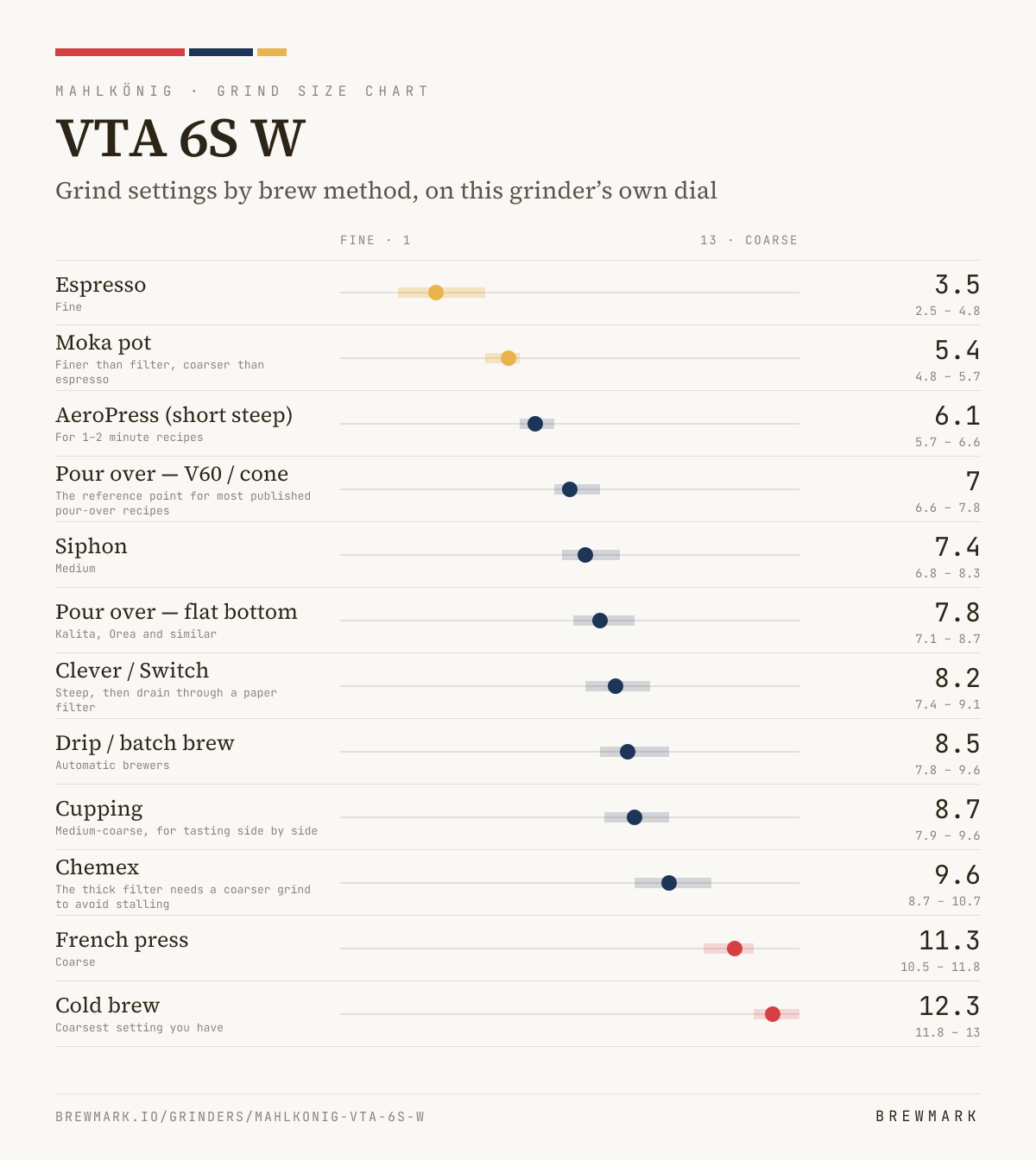
How much room you have to adjust
That is the resolution you actually have to work with on the VTA 6S W. Where the number is small, a single step moves the cup more than you would expect — so change one at a time and taste before moving again.
Coming from another grinder?
Convert a grind setting to the VTA 6S W
If a recipe quotes a setting for a different grinder, this maps it onto the VTA 6S W’s dial using the same curve the chart above is built from.
Converting between two grinders that are not this one? Open the full converter.
Owners’ particle-size readings
No readings for the VTA 6S W yet. If you own one, you can measure your grind with a phone photo; readings are reviewed, then shown here.
How these numbers were worked out
Every grinder gets mapped onto a shared 0–100 grind index, where 0 is espresso-fine and 100 is the coarsest useful setting. Five reference points on the VTA 6S W are placed on that scale — espresso, moka, filter, French press and coarse — and the settings in between are interpolated.
The VTA 6S W joined the catalog in October 2026. Mahlkönig doesn’t publish a brew-method chart for it that we could find, so its reference points are estimated by comparison with grinders whose makers do. W version (weighing/retail variant); HCG data identical to VTA 6S. We couldn’t confirm whether these numbers are printed on the grinder or counted from where the burrs touch, so check your own dial before relying on the ends of the range. They are a starting point rather than a specification; if your VTA 6S W reads differently, tell us.
The VTA 6S W’s dial is interpolated linearly between those reference points, which is the right model for its burr geometry.
The result is that “medium-fine” resolves to a real number on this grinder rather than a vague instruction. It is a starting point, not a guarantee — burr wear, bean density and roast level all move the target, which is why every row above gives a range as well as a number.
Own a VTA 6S W? Tell us your setting
If you’ve dialled in a method on your own VTA 6S W, the number you landed on is the best evidence there is. Readings are checked by hand before anything changes here.