
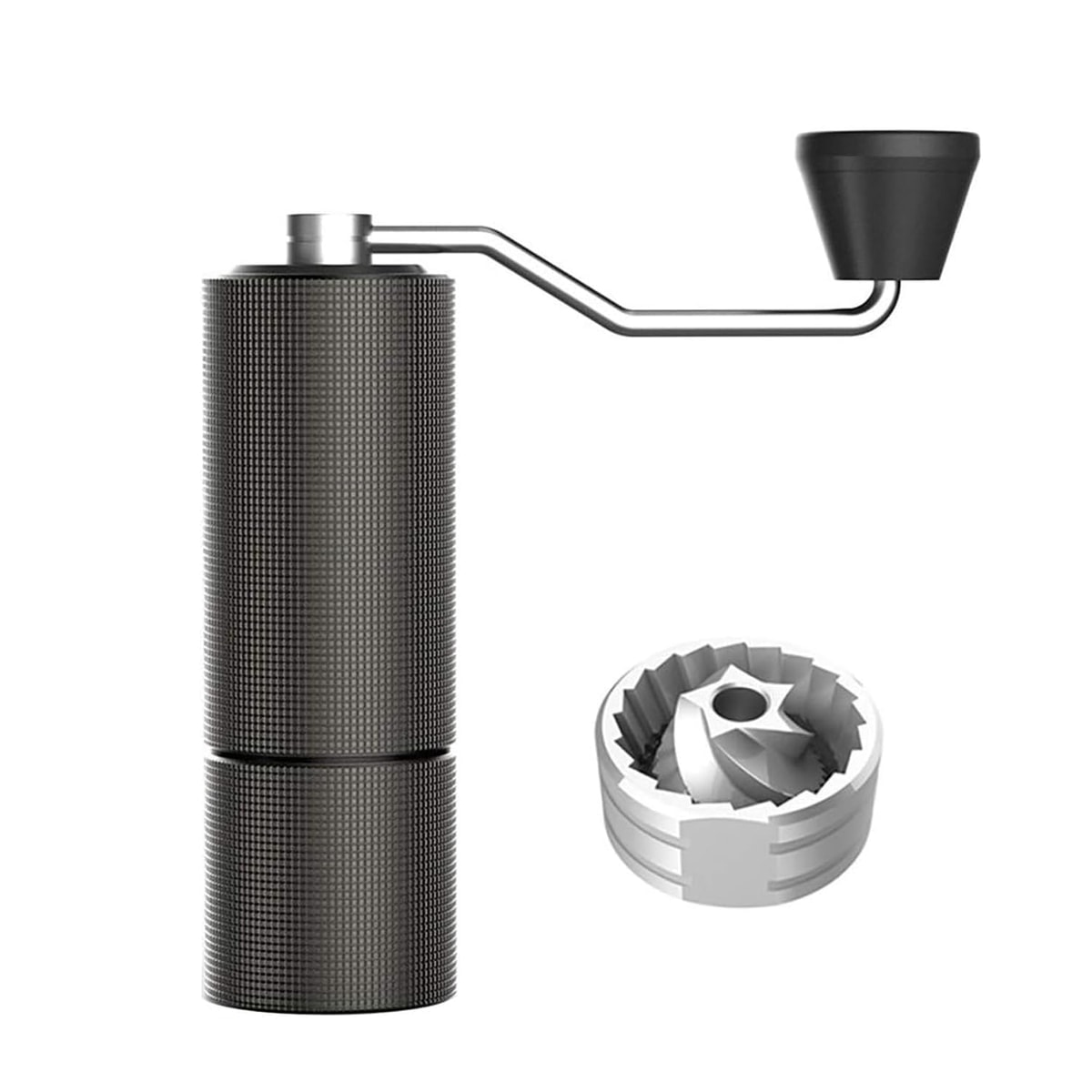
 Timemore C2
Timemore · Dial-in chart
Timemore C2 grind settings
On the Timemore C2, start pour over at 16 clicks, espresso at 9 clicks and French press at 22 clicks. Every other method, with the range to adjust in, is below.
The shape of this dial
The top line is the universal grind index every BrewMark recipe uses. The bottom line is the C2’s own dial. The connectors show how one maps onto the other.
C2 grind size chart, by brew method
Start at the recommended setting, brew, then move within the range by taste. Sour or weak means go finer; bitter or harsh means go coarser. New to the C2? Start here.
| Method | Setting | Range |
|---|---|---|
| EspressoFine. Aim for a 25–30s shot and adjust from there.First recipe → | 9 clicksestimated | 8 clicks – 11 clicks |
| Moka potFiner than filter, coarser than espresso. No tamping.Recipe → | 12 clicksestimated | 11 clicks – 13 clicks |
| AeroPress (short steep)For 1–2 minute recipes. Go coarser for longer steeps.Recipe → | 14 clicksestimated | 13 clicks – 15 clicks |
| Pour over — V60 / coneThe reference point for most published pour-over recipes.First recipe → | 16 clicksestimated | 15 clicks – 17 clicks |
| SiphonMedium. Short contact over steady heat, so start here and taste. | 16 clicksestimated | 15 clicks – 18 clicks |
| Pour over — flat bottomKalita, Orea and similar. Slightly coarser than a cone.Recipe → | 17 clicksestimated | 16 clicks – 18 clicks |
| Steep and release — Clever / SwitchSteep, then drain through a paper filter. If it drains slowly, go coarser.Recipe → | 18 clicksestimated | 16 clicks – 19 clicks |
| Drip / batch brewAutomatic brewers. Coarser to suit the longer contact time.First recipe → | 18 clicksestimated | 17 clicks – 20 clicks |
| CuppingMedium-coarse, for tasting side by side. Keep it the same across every bowl. | 18 clicksestimated | 17 clicks – 20 clicks |
| ChemexThe thick filter needs a coarser grind to avoid stalling.Recipe → | 20 clicksestimated | 18 clicks – 21 clicks |
| French pressCoarse. Too fine here is the usual cause of a muddy cup.First recipe → | 22 clicksestimated | 21 clicks – 24 clicks |
| Cold brewCoarsest setting you have. 12–18 hours of contact.Recipe → | 25 clicksestimated | 24 clicks – 27 clicks |
Timemore doesn’t publish a brew-method chart we could find, so these are estimated from comparable grinders. If your C2 reads differently, tell us.
Every grinder on one grind size chart →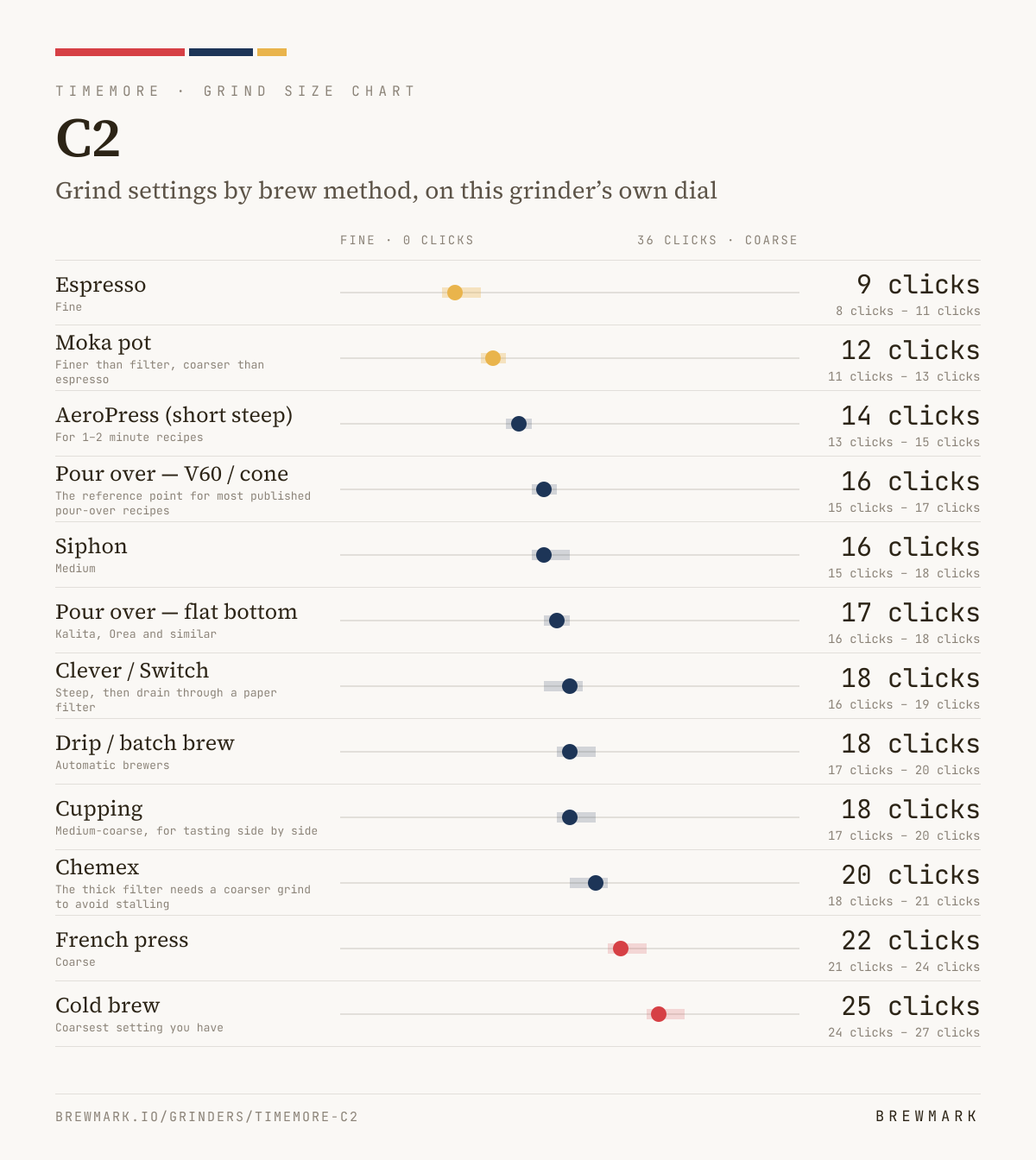
Not yours yet?Buy a used C2 if you brew pour-over, AeroPress or French press and want a fast, light hand grinder; skip it if you want espresso. The C2 buying guide →
New to this grinder?
Your first cup on the C2
- 01
Read the dial
Settings count clicks from zero, the finest the dial goes. Turn it finer until it stops, then count clicks back the other way.
- 02
Set the starting point
Find your brew method in the chart above and set its number. For pour over on the C2, that is 16 clicks.
- 03
- 04
Change one thing at a time
Make one small change to the grind and brew again, keeping the coffee, dose and water the same. The range beside each method is how far to go before something else is the problem.
Words on this pageGrind size · Conical burrs · Grind index · Extraction · Dialing in
Goes with your C2
What makes these settings work
A setting only repeats if the dose and the pour do too. Picked for how this grinder is used, not ranked, and nothing here is sponsored. Each one links to the guide that explains it.
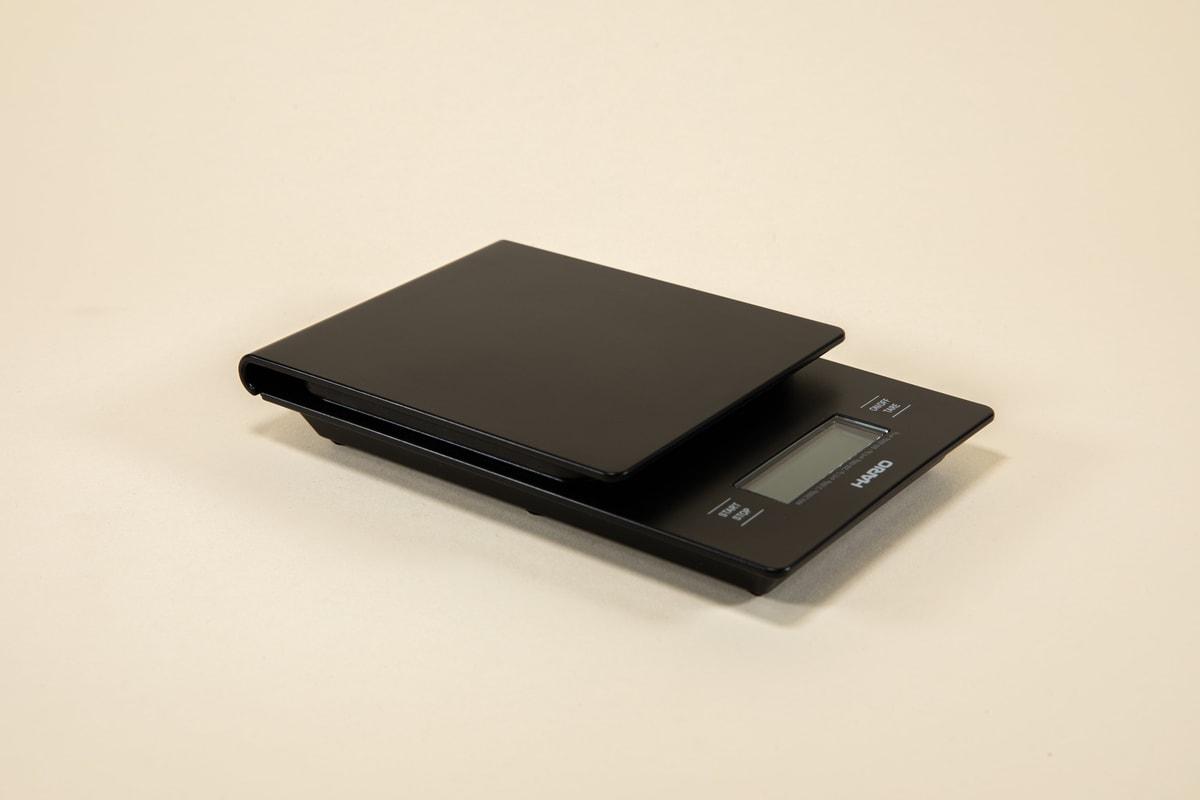 ScaleHario V60 Drip ScaleWeigh the beans and the water, and a sour cup points at the grind, not the dose.How to choose a coffee scale →
 KettleHario V60 "Buono" Drip Kettle 1.2LA slow, steady pour is what lets the same setting give the same cup.How to choose a gooseneck kettle →
 DripperHario V60 Ceramic Coffee Dripper 02The cone most pour-over settings and recipes are written for.How to choose a pour-over dripper →
 FiltersHario V60 Paper Filter for 02 Size DripperOther papers drain faster or slower and shift the setting you need.How to choose coffee filters →
How much room you have to adjust
That is the resolution you actually have to work with on the C2. Where the number is small, a single step moves the cup more than you would expect — so change one at a time and taste before moving again.
Dialing in the C2
The C2 is the predecessor to the C3 and remains the cheapest genuinely usable hand grinder. Its range covers filter and immersion adequately; expect more variation shot-to-shot than the C3, particularly at the fine end.
Coming from another grinder?
Convert a grind setting to the C2
If a recipe quotes a setting for a different grinder, this maps it onto the C2’s dial using the same curve the chart above is built from.
Converting between two grinders that are not this one? Open the full converter.
Owners’ particle-size readings
No readings for the C2 yet. If you own one, you can measure your grind with a phone photo; readings are reviewed, then shown here.
How these numbers were worked out
Every grinder gets mapped onto a shared 0–100 grind index, where 0 is espresso-fine and 100 is the coarsest useful setting. Five reference points on the C2 are placed on that scale — espresso, moka, filter, French press and coarse — and the settings in between are interpolated.
Timemore doesn’t publish a brew-method chart for the C2 that we could find, so its reference points are estimated by comparison with grinders whose makers do. They are a starting point rather than a specification; if your C2 reads differently, tell us.
Because the C2 uses conical burrs, the curve between those points is fitted with a monotone cubic spline rather than straight lines. Conical burr dials are rarely linear, and the spline guarantees the curve never doubles back — a coarser index always produces a coarser setting.
The result is that “medium-fine” resolves to a real number on this grinder rather than a vague instruction. It is a starting point, not a guarantee — burr wear, bean density and roast level all move the target, which is why every row above gives a range as well as a number.
Corrections to this page
- 2026-09-14Pour over is now 15 clicks on the C3 and 16 on the C2, with French press and cold brew corrected to match.
Own a C2? Tell us your setting
If you’ve dialled in a method on your own C2, the number you landed on is the best evidence there is. Readings are checked by hand before anything changes here.